
The Datacenter Playbook: How Big Tech Is Copying Big Oil’s Native Advertising Tactics


We’ve seen this story before. A struggling region needs economic relief. An industry arrives with promises of jobs, tax revenue, and progress. Sleek, editorial-style content – indistinguishable from journalism – celebrates the arrival of prosperity. Local concerns about environmental damage, strain on infrastructure, and resource depletion get buried beneath narratives of regional rescue.
This has been the fossil fuel industry’s playbook. And now, as communities push back against unchecked artificial intelligence datacenter expansion, Big Tech is executing the same strategy.
But here’s what makes this moment urgent: the playbook is already working. A new study from Boston University’s College of Communication found that Americans dramatically underestimate opposition to datacenters within every political group. Overall, 53% of Americans believe Republicans support datacenter construction, when in reality only 34% do – while 37% are actually opposed. The perception gap is staggering among Independents too: only 28% believe Independents oppose datacenters, though 56% actually do. When people hold misperceptions about what their neighbors and political peers actually think, native ads can reinforce and amplify those misunderstandings, making them seem more credible and inevitable. This is especially true for Republicans caught between personal opposition to datacenters and their party leadership’s unqualified support – a cross-pressure that leaves many uncertain and vulnerable to whatever narrative seems most authoritative.
The Chevron Playbook: 2019
In 2019, The Atlantic published what appeared to be a human-interest story: “Tuffy and the Comeback of the Coal Capital of the World.” It was beautifully written, genuinely compelling, and – unbeknownst to many readers – sponsored by Chevron.
The piece profiled Tuffy Shallenberger, a Pennsylvania construction company owner whose business expanded from 50 to 300 employees by serving the natural gas boom. It celebrated his reinvestment in the community (such as youth soccer sponsorships and ownership of a professional soccer team) and framed fossil fuel extraction as an economic savior for Appalachia.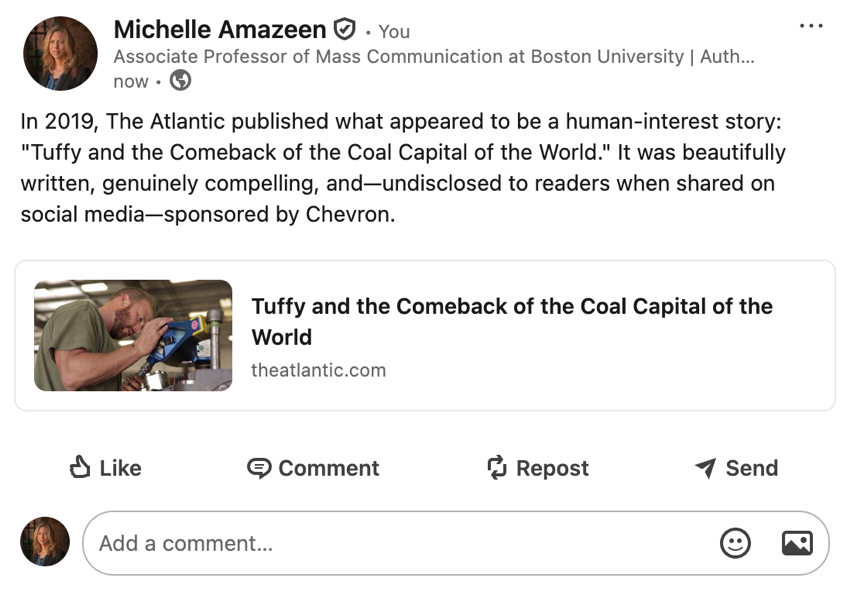
Why did Chevron invest in this narrative at that moment? Corporate strategists understood what researchers have long documented: native advertising – content that mimics journalism’s format and credibility – is far more persuasive than traditional advertising because readers process it as truth.
Here’s how the playbook works:
- Borrow Credibility: The Atlantic is a century-old publication with intellectual prestige. By embedding their narrative within The Atlantic’s ecosystem, Chevron leveraged that authority. Readers trusted the story because of who published it.
- Shift the Focus: Instead of drills, trucks, and chemical fluids, Chevron profiled “Tuffy,” a sympathetic, hard-working local. This reframed the industry not as extractive outsider, but as benevolent partner fueling the American Dream.
- Influence Policy Elites: The Atlantic’s readership is concentrated among policymakers, politicians, and cultural influencers. When politicians debate tightening fracking regulations or taxing carbon, a narrative showing a community “saved” by energy production provides powerful cover for deregulation.
The Reality Chevron Didn’t Tell
Here’s what the native ad omitted: whether the fracking boom was actually good for Southwestern Pennsylvania remains intensely contested.
Although the macroeconomic gains were real, with Appalachian fracking counties growing economically, a landmark study by the Ohio River Valley Institute found that roughly 90 percent of the wealth leaked out of the region to out-of-state energy corporations. The counties actually declined in their share of national personal income and jobs.
Meanwhile, the local health costs have been devastating. According to University of Pittsburgh and Pennsylvania Department of Health research:
- Children within one mile of active wells were 5 to 7 times more likely to develop rare childhood lymphomas
- Severe asthma and respiratory illness spiked near production sites
- Infant birth weights dropped significantly in proximity to wells
- Tens of thousands of poorly plugged wells continue leaking methane and threatening groundwater
The boom created short-lived prosperity while leaving behind long-term environmental degradation and serious chronic health crises.
Tech Giants Copy the Playbook
Now we can watch it unfold for AI datacenters.

Fortune and AMD: “Powering the Data Center of the Future” targets enterprise decision-makers and policymakers, arguing that building AI infrastructure is a national necessity for American competitiveness.
The New York Times and Siemens Energy: “Unlocking the Grid” acknowledges a real anxiety: AI’s staggering demand on electrical infrastructure. However, it reframes datacenters not as resource drains but as catalysts for updating America’s aging infrastructure. Tech companies become modernizers, rather than another strain on resources.
CNBC and Ecolab: A water-management firm produces native ad content warning that “if we don’t find ways to produce more with much less water, there will be no AI.” The crisis becomes an opportunity with tech companies as problem solvers.
Content Confusion at Scale
Like Chevron’s “Tuffy” campaign, these native ads use high-end journalistic aesthetics to obscure harsh realities. They drown out grassroots opposition, including recent bipartisan pushes for federal datacenter moratoriums, by replacing images of strained power grids, water depletion, and noise pollution with narratives of civic progress and technological rescue.
The playbook works because most readers don’t notice the label “sponsored content,” or “paid content,” or whatever the publisher decides to call it (since no standardization exists). Their brains process it as journalism. The industry narrative settles in as common sense. This perception gap isn’t random. It’s precisely the space where native advertising thrives. When Republicans are uncertain whether their party actually opposes datacenters, or when Independents can’t see that a majority of their peers do, a sleek native ad from a trusted publication can resolve that uncertainty by making one narrative seem inevitable and credible.
As communities face decisions about datacenter expansion, we need to ask: Who is funding these stories? What’s not being shown? What would this industry rather you not think about?
Recognizing the playbook is the first step to resisting it.
Michelle A. Amazeen is Associate Professor and Director of the Communication Research Center at Boston University’s College of Communication. She is the author of Content Confusion, which explores the challenges facing digital news and media trust.